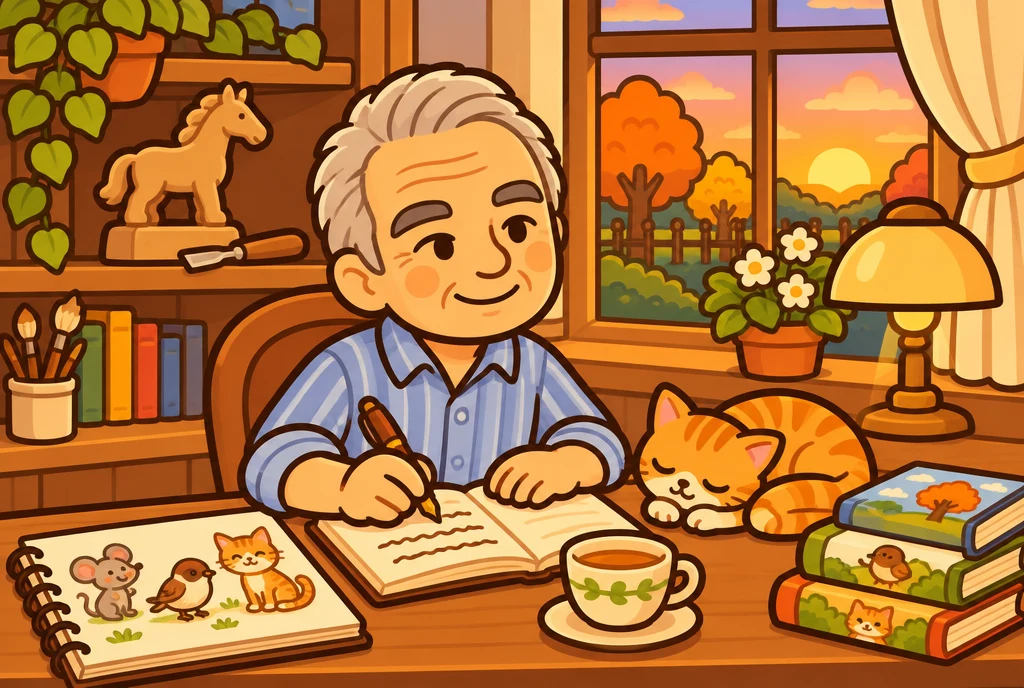
Every studio has a first client. Ours was our dad. Yuri Gaponov has written poems for children and for the whole family for as long as we can remember: cats and mice, sparrows and spiders, the small dramas of a backyard. For many years he worked as a sculptor in the USSR, and he still draws beautifully. The first copies of his books were illustrated by hand, page by page.
When sponsors helped print the book “Whiskered, Tailed and Winged” for kindergartens, we saw how children reacted to it. They did not just listen. They wanted to be the mouse sneaking past the cat, to chase the bread crumbs with the sparrow. That is where Apricat began: a game studio in Melbourne whose first games grew out of a family book.
One poem, one game
We kept a simple rule: each game starts with its poem, read aloud, and then the poem comes to life. Nothing in the game should contradict the verse.
- Mouse and Cat. The mouse has to carry the cheese home while the cat isn't looking. It is a game about timing and patience, exactly like the poem.
- Hungry Sparrow. Peck the bread on the path and dodge the passers-by, or fly up out of their way.
- Echo. Wake the forest animals one by one, then repeat the order. A memory game hidden inside a lullaby.
Why the browser first
Parents and teachers should not need to install anything to try a game. So we build for the browser first: the same game opens on a laptop, a tablet or a phone. Once a game is loved, the same code goes to the App Store and Google Play. There are no ads, no accounts and no tracking, which matters a lot when the players are three to eight years old.
Read aloud in two languages
Our family speaks Russian and English, and so do many families in Melbourne. Every poem is read aloud in both languages, and the youngest players can switch on a watch-and-listen mode where the game plays itself while the poem is read.
What it taught us as a studio
Turning a picture book into a game is a craft of its own: you keep the author's voice, the rhythm of the text and the pictures children already know, and you add just enough play. It is the same work we now do for other authors, brands and schools. Dad keeps writing new poems, and he says the best part is hearing from the children who play them.